
Author: Céline Arslene
Leadership is often measured by visibility – who speaks, who is invited, who is seen. Yet across the world, many women remain excluded not because they lack ability, but because the systems around them were never built to include them.
This article is part of Leading Beyond Borders, a Women Beyond Borders mini-series spotlighting women who are reshaping leadership across systems, sectors, and societies. Through their work, we explore what it means to move beyond visibility and into decision-making power – and how leadership rooted in justice, access, and community can transform who gets to shape the future.
Beyond Visibility: Access as a Feminist Question
Some leaders focus on visibility. Others focus on access. For Soohemba Aker, the question is not only who is present in the room, but who is allowed to shape decisions once inside it.
Working at the intersection of gender, governance, and technology, Soohemba leads NOBUL Africa Foundation, where her work focuses on expanding leadership, innovation, and civic participation for young people, particularly women from communities systematically excluded from opportunity. Her approach begins with a reality many systems resist acknowledging: talent is universal, but access is deeply political.
When Systems Exclude, Silence Is Structural
Soohemba’s path was shaped by witnessing capable individuals remain invisible, not due to lack of skill, but because the systems surrounding them were never designed for inclusion. This disconnect became stark during Nigeria’s #EndSARS protests, when young people demanded accountability from institutions they had never been meaningfully allowed to access.
Rather than responding with short-term advocacy, her work moved toward a more structural question: ‘What does it mean to build systems that women and young people can enter, influence, and transform?’ The answer, for Soohemba, lies in institution-building, creating pathways not only for participation but for power.
From Tokenism to Decision-Making
Much of Soohemba’s work challenges a familiar pattern: women are invited to participate, consulted symbolically, and celebrated rhetorically, yet excluded from real decision-making. Her focus is on moving women beyond representation and into positions where they shape policy, allocate resources, and define priorities.
This shift, from inclusion as presence to inclusion as authority, is central to her leadership. It reframes women not as beneficiaries of systems, but as architects of them.
Leading as a Young Woman: Resistance as a Political Signal
Operating in law, development, and policy spaces has meant confronting deeply entrenched hierarchies. As a young woman leader, Soohemba has faced resistance in environments where women are often welcomed as implementers but questioned as decision-makers.
Beyond explicit exclusion, there is a quieter pressure to shrink, to wait longer, soften ambition, or repeatedly justify legitimacy. Choosing to occupy space confidently, without apology, became both a personal stance and a political act.
What sustains this work is clarity of purpose. In moments when funding stalled or leadership was challenged, returning to the core mission provided grounding. Equally vital has been collective support, mentors, collaborators, and peers who recognize that resistance often signals disruption, not failure.
Structural Barriers Demand Structural Change
The challenges facing women in Nigeria, Soohemba emphasizes, are not isolated or individual; they are systemic. Women continue to face exclusion from leadership, economic opportunity, and political participation. Cultural norms still confine ambition, while access to education, technology, and capital remains uneven, particularly for women in rural or conflict-affected communities.
Although gender equality may be acknowledged in policy, implementation consistently lags. This gap between commitment and practice continues to limit women’s ability to move from participation to power.
What Accountability Looks Like
For meaningful progress, Soohemba identifies three urgent shifts.
First, opportunity must be decentralized. Gender justice cannot be achieved if resources, platforms, and influence remain concentrated in a few urban or elite spaces.
Second, women must be trusted and invested in as leaders and innovators, not treated solely as recipients of support. This requires funding women-led ideas, opening policy spaces, and building pathways for sustained leadership.
Finally, institutions must be held accountable for inclusion as a measurable outcome, not a symbolic promise. Gender equality cannot remain aspirational; it must be enforceable.
A Collective Call Forward
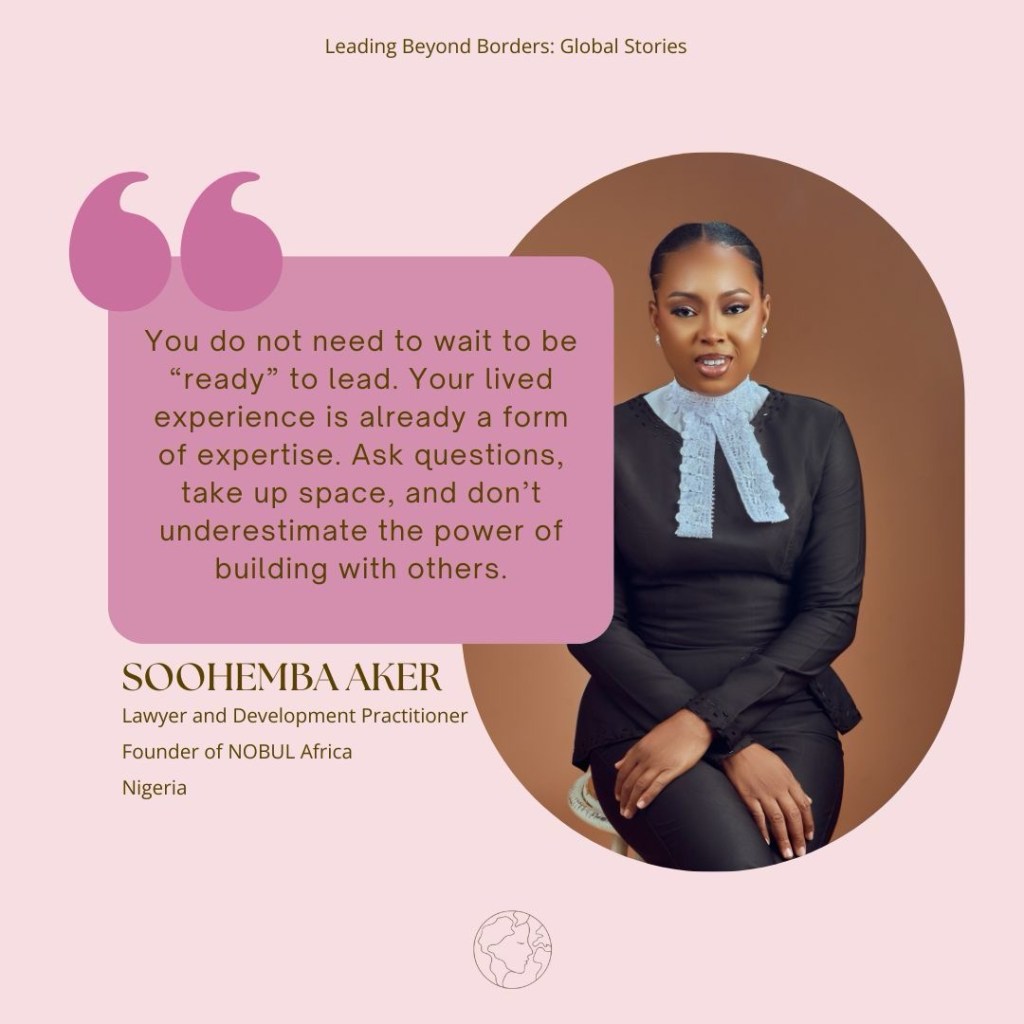
To young women navigating exclusion across contexts, Soohemba’s message is clear: leadership does not require permission. Lived experience is expertise, and readiness is built through participation, not waiting.
Social change does not happen because a few women break barriers, it happens when many women are no longer asked to justify their presence.
Redefining Legacy
When reflecting on legacy, Soohemba looks beyond programs, titles, or individual recognition. What matters is whether more women from overlooked communities are shaping policy, leading institutions, and building solutions, without having to explain why they belong there.
When that becomes the norm, the system itself will have begun to change.
 WBB: Women Beyond Borders
Leave a comment