
An essay on modern leadership, women’s leadership, and how digital communities like Women Beyond Borders are reshaping leadership through presence, openness, and collective practice.
Author: Yoyo Yip
Editor’s note:
This piece is written by Yoyo, who leads the Postcard Project at Women Beyond Borders – from its initial idea and design to its implementation and ongoing evolution.
Women Beyond Borders exists to support women navigating life and leadership across borders, while actively spotlighting women who are shaping new ways of leading. It therefore felt only natural to feature a leader from within our own WBB Team in our Leading Beyond Borders series.
Below, Yoyo reflects on leadership, presence, and community – not as fixed concepts, but as practices we learn through connection.
We’re honoured to share her perspective.
As evolving creatures, we inevitably come to embody the repository of philosophies we’ve collected through observation, taught through conversation, and inherited through family. When I was thinking about the question of leadership, those were the directions that my mind pointed in first: my own community.
In truth, I have still yet to come to terms with what leadership looks like. World leaders come to mind. Maybe local community members with outstanding abilities to rally the masses, or a student leading their small group project to an A+. Yet this figureless definition offers no tidy set of instructions to follow (I did Google “how to be a leader” and read through the first WikiHow page, but I digress). Indeed, such a manual would have come in handy when trying to write this article.
Still, I will endeavour, with the limited knowledge and word count I have, to best explain leadership as it is from my mind’s eye.
There are certain qualities of a leader that I find essential. To better illustrate this, I turn to an urban sociology concept I came across: the “blasé” attitude, coined by Georg Simmel in The Metropolis & Mental Life. In essence, Simmel argued that as a result of the overstimulation that we experience in modern metropolitan life, we have adopted an attitude of detachment in order to survive the urban jungle with our sanity intact. This meant greater individualism, mental walls within communities and cities; you could be living in the densest and most populated city, and yet feel nothing at all. For me, this idea arguably extends beyond urban life, especially in a digital age when disengagement is as easy as turning off your phone.
But leaders, of all people, cannot simply turn it off. That’s not to say they do not deserve the same grace as others to enjoy peace and quiet once in a while. Rather, leadership demands a presence that runs counter to the blasé. It is a deliberate choice to remain engaged when disengagement would be easier, more comfortable, perhaps even more rational given the circumstances.
This is where I think the difficulty of leadership truly lives. Not in the grand gestures or the rousing speeches, but in resisting that pull toward detachment. In continuing to show up, to pay attention, to notice the person who’s gone quiet in meetings or the shift in energy when a decision lands poorly. It’s exhausting, and surely the opposite of self-preservation in many ways.
I think back to all those roles I’ve inhabited: mentor, student, follower, friend, designer, artist. and what strikes me now is how each one required a different calibration of presence. As a follower, you could afford some distance. You could observe, critique, withhold. But as a leader, or more accurately, as someone trying to lead, that distance collapses. People are looking to you not just for direction but for cues on how to be, how to react, whether it’s safe to speak up or better to stay quiet.
This feeling is most acute when you’ve occupied both sides of the equation. When you’ve been the student sitting across from a mentor who talks at you instead of with you, who performs their expertise instead of actually teaching, you understand the difference in a way you can’t unlearn. When you’ve been the artist trying to articulate some half-formed vision that exists more as feeling than concept, you recognise the value of a leader who can hold space for uncertainty. Someone who doesn’t need you to arrive with a three-point plan and a clear timeline before they’ll take you seriously, who can sit with the discomfort of not-knowing and trust that something will emerge from it.
Each role has taught me something about what people actually need from their leaders: to be seen as whole people, not just resources or assets or problems to solve. To be trusted with uncertainty instead of just handed instructions. To have their expertise valued, actually valued, not just acknowledged and then ignored. To feel safe enough to risk being wrong, to ask the stupid question, to admit they don’t know. To believe that someone will catch them if they fall, or at least help them get back up.
Leadership requires you to stay permeable, to let things in even when it would be so much easier not to.
This is where communities like Women Beyond Borders become essential. If the blasé attitude is about building walls to survive overstimulation, then perhaps communities offer something like a counter-architecture: a way to remain connected without being consumed.
I think about how isolating it can feel to try to lead differently. When everyone around you is performing certainty, performing strength, you start to doubt yourself. You start to think maybe you’re the problem. But then you find a community of people who are also asking those questions, who are also trying to figure out how to lead without replicating harm, and suddenly you’re not alone in it anymore. Suddenly there’s a collective practice of leadership as opposed to an individual struggle.
These communities model a different kind of leadership structure altogether. Not hierarchical, not about one person at the top dispensing wisdom. More distributed, more collaborative. Leadership as something that moves between people depending on who has the relevant experience, who has the energy in that moment. It’s leadership that acknowledges we’re all still figuring this out.
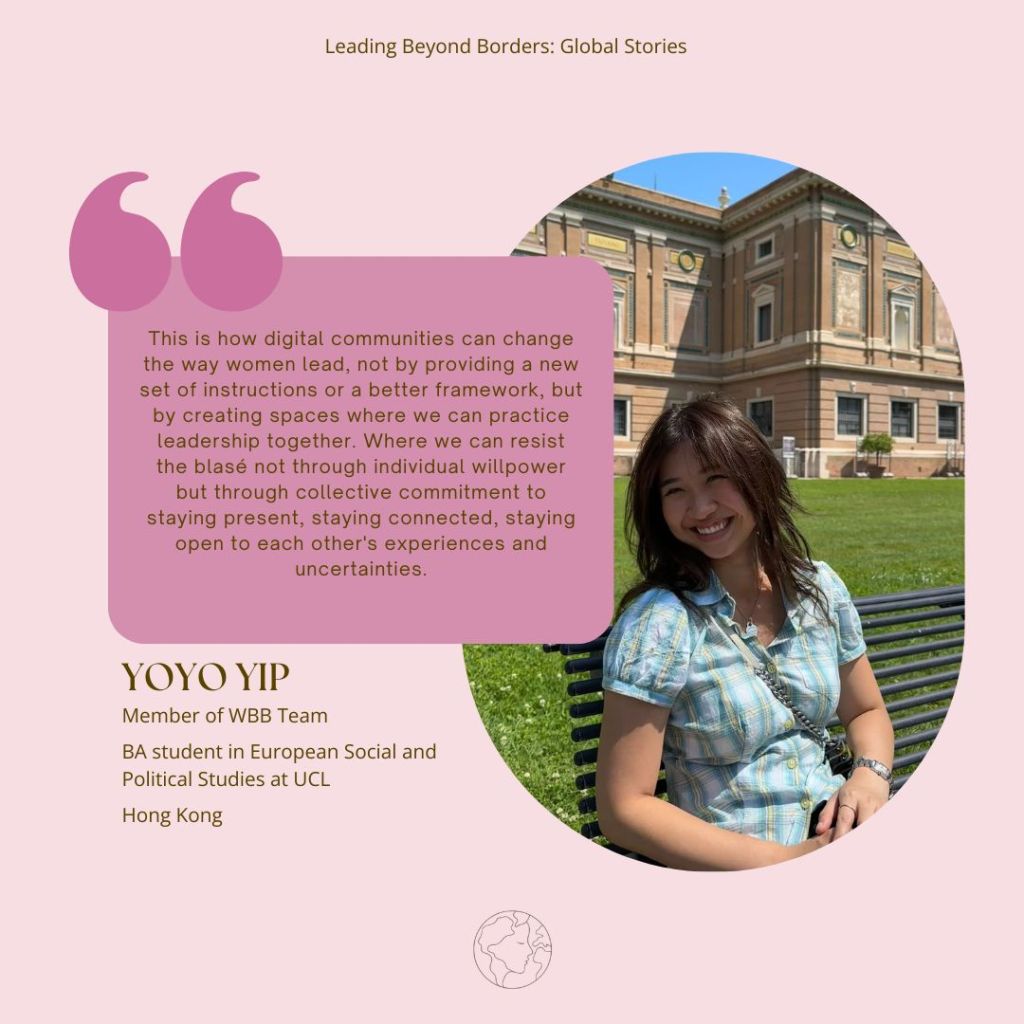
This is how digital communities can change the way women lead, not by providing a new set of instructions or a better framework, but by creating spaces where we can practice leadership together. Where we can resist the blasé not through individual willpower but through collective commitment to staying present, staying connected, staying open to each other’s experiences and uncertainties.
Indeed, even with community, even with that collective practice, I struggled to put my thoughts into words for this. Possibly because the version of leadership I’m trying to articulate isn’t about certainty or strength or having it all figured out. It’s about the harder, quieter work of remaining open in a world that teaches us to close off. of choosing connection over detachment, even when – especially when – detachment would be the more comfortable option.
Thus, in some regards, I suspect I am an optimist feigning pragmatism.
Which is to say, I believe in the possibility of leadership that doesn’t replicate the same tired patterns, even as I’m acutely aware of how difficult that is. I believe people can lead without performing infallibility, without demanding that everyone else shrink to make room for their vision, without mistaking control for competence. But I also know that belief alone doesn’t make it so. That good intentions don’t exempt you from causing harm. That sometimes the most well-meaning leaders are the ones who fail to notice they’ve stopped listening.
This tension, between hope and skepticism, between wanting to lead well and doubting whether you’re capable of it, lives at the center of how I think about leadership now. Arguably it should live there. Perhaps the leaders who are too certain, too comfortable, too sure of their own righteousness are precisely the ones we should worry about most.
I’ve come to think of leadership less as a position you occupy and more as a practice you engage in, something you do rather than something you are. And like any practice, it requires repetition, failure, adjustment. You show up. You pay attention. You make a decision that feels right in the moment and then watch it land badly and have to reckon with that. You listen to feedback that stings because it’s true. You notice the room’s energy shift and have to decide whether to name it or let it pass. You hold space for someone else’s uncertainty while managing your own.
I don’t know if this constitutes a leadership philosophy, but it’s the best I can describe it right now: a commitment to staying permeable in a world that rewards detachment. to choose a connection even when it costs something. To believe, maybe naively, that there might be another way to do this and being willing to fail repeatedly in pursuit of it.
Because in the end, maybe that’s what leadership is. Not the absence of doubt, but the decision to act despite it. Not certainty, but the willingness to move forward in uncertainty. Not having all the answers, but creating the conditions where others feel safe enough to ask the questions.
For the moment, we are all simply trying to put one foot forward at a time, and I am certain that’s more than enough.
 WBB: Women Beyond Borders
Leave a comment