
After almost 30 years in the Department of Bioethics at the National Institutes of Health Clinical Center, including 14 years as chair, Dr. Christine Grady recently entered a new chapter in her professional life. Like many leaders who have dedicated decades to a single institution, she found herself reflecting on a question she has helped others consider throughout their careers: What is my purpose now? For someone who spent decades guiding healthcare professionals through complex ethical decisions, navigating her own transition offered both perspective and clarity.
This conversation feels especially timely. Healthcare professionals today face increasing ethical complexity – balancing limited resources, evolving technologies, institutional priorities, and patient needs. Many experience what is known as moral distress: the tension that arises when circumstances constrain what they believe is the right course of action. Women, in particular, often navigate these systems while still building confidence in how to voice ethical concerns and leadership perspectives. Bioethics provides structured frameworks and language that can help professionals approach these dilemmas more thoughtfully and constructively.
Dr. Grady brings deep expertise to these discussions. She is an author and editor of the Oxford Textbook of Clinical Research Ethics, has served on the Presidential Commission for the Study of Bioethical Issues, and is a member of the National Academy of Medicine. Her perspective is shaped not only by academic achievement, but by lived experience – transitioning from nursing to philosophy, contributing to ethical capacity-building in healthcare systems from Brazil to Uganda, engaging with emerging questions around AI and neurotechnology, and reflecting on purpose during professional change.
This article draws on insights from our podcast conversation with Dr. Grady. Rather than offering generic career advice, it shares grounded reflections from a leader who has worked through major global health challenges – including HIV, Ebola, and COVID-19 – and who continues to think deeply about ethics, leadership, and purpose in times of transition.
Who Is Christine Grady and Why Her Career Path Matters
Here’s the thing about Christine Grady’s career: she couldn’t have planned it. When she graduated with a nursing degree in the 1970s, bioethics as a formal field barely existed. Women had limited career options, and “nurse bioethicist who shapes global health policy” wasn’t on anyone’s vision board.
She started as a nurse in several Massachusetts hospitals. At Tufts New England Medical Center, she worked on a unit that was doing experimental bone marrow transplants. The work was intensive – sometimes two nurses per patient, months of care with the patient inside sterile plastic tents. But something bothered her. These patients received extraordinary resources while people down the street in Boston couldn’t access basic prenatal care. The disparity felt wrong, but she didn’t yet have the tools to articulate why.
That ethical tension followed her to northeast Brazil, where she worked for Project HOPE in a large federal hospital serving an impoverished state. Limited resources meant constant triage decisions about who received treatment and when. Then came her work at NIH during the early HIV epidemic, caring for young men – people who could have been her brother or best friend – facing both a devastating illness and crushing social stigma.
The pattern became impossible to ignore. Ethical questions kept surfacing across every role, every country, every patient population. So she did something uncommon: she pursued a PhD in philosophy at Georgetown while continuing her NIH clinical work. Not because she had a master plan, but because she needed better tools to think through the questions plaguing her.
The timing turned out to be fortunate. Just as she finished her doctorate, the NIH Clinical Center created a Department of Bioethics. She joined as a founding member and became chair after about 12 years, leading the department for many years .
Her international work expanded from there – HIV vaccine trials in Uganda, research ethics workshops across Africa and Southeast Asia. She authored and edited the Oxford textbook of clinical research ethics, served on the Presidential Commission for Bioethical Issues, and received the Lifetime Achievement Award from the American Society for Bioethics and Humanities along with several NIH Director’s Awards and honorary doctorates.
The broader lesson matters more than the accolades. Grady’s career path illustrates something essential for women professionals: you can’t always plan for fields that don’t yet exist. What you can do is follow genuine curiosity and opportunities, recognize patterns across different roles, and build expertise at the intersection of emerging needs.
What Bioethics Actually Is and Why It Matters Beyond Hospitals
If you’re a nurse, physician, researcher, or public health professional, you’re already doing bioethics work – you just might not call it that. Every time you’ve wrestled with whether a desperate patient truly understands the risks they’re consenting to, or wondered how to fairly allocate limited resources between competing needs, or questioned the ethics of a clinical trial design, you’ve been navigating bioethical terrain.
Bioethics is a branch of moral philosophy focused on how we ought to act in healthcare, medical research, public health, and health policy contexts. It’s the systematic inquiry into difficult questions that arise when science, medicine, and human values collide. What’s the right thing to do in this situation? How do we balance individual needs against community needs? Who gets to decide? How do we make decisions when fundamental values conflict?
Broader than medical ethics, bioethics addresses systemic questions, not just bedside dilemmas. Medical ethics tends to focus on the patient-clinician relationship and individual care decisions. Bioethics zooms out to ask bigger questions about resource allocation, research design, policy frameworks, and institutional practices that shape entire systems.
The work happens in three overlapping domains. There’s scholarship – research and writing that explicates ethical issues and builds ethical frameworks. There’s policy development at institutional and governmental levels, creating guidelines that shape how clinicians practice and healthcare systems operate. And there’s practice – ethics consultation when patients, families, clinicians, researchers, and others face difficult decisions and need help thinking through options.
Most people hear “bioethics” and immediately think of headline-grabbing controversies: cloning debates, euthanasia, gene editing. Those issues matter, but they’re not the bulk of the work. Dr. Grady spent decades wrestling with questions like: Should we prioritize experimental treatments for a few patients or basic care for many? How do we design HIV vaccine trials ethically when participants come from vulnerable populations? What constitutes genuine informed consent when patients are desperate for treatment and would agree to almost anything?
These everyday questions about informed consent, clinical trial design, and fair resource distribution are where bioethics lives in practice. They’re the type of questions that healthcare professionals encounter constantly, often under pressure with limited time to deliberate. Understanding ethical frameworks doesn’t make these decisions easy, but it does provide tools for thinking through them systematically rather than relying solely on gut instinct or institutional inertia.
As a field, bioethics is growing more relevant, not less. AI in healthcare raises urgent questions about bias, privacy, and the role of human judgment. Neurotechnology that can read thoughts challenges our understanding of autonomy and consent. Pandemic response forces impossible trade-offs between individual liberty and collective health. Global health inequities demand we confront who gets access to life-saving interventions and why.
You’re already in these conversations whether you recognize them as bioethics or not. The framework just gives you language and tools to navigate them more intentionally.
The Moral Distress Crisis and Grady’s Framework for Moral Strength
If you’ve ever known exactly what your patient needed but couldn’t provide it because of insurance constraints, or recognized a problematic protocol but felt powerless to challenge it, you’ve experienced moral distress. And if you work in healthcare, you’ve probably felt it more often than you’d like to admit.
Understanding Moral Distress
Moral distress was first described among nurses, but Grady’s insight reveals it’s not unique to healthcare at all. The phenomenon occurs whenever you know the right thing to do but cannot do it due to constraints – authority structures, limited resources, systemic barriers, or time pressure.
Healthcare environments create particularly fertile ground for moral distress because almost every decision involves multiple stakeholders with conflicting values. You’re navigating the patient’s wishes, the family’s expectations, your healthcare team’s assessment, institutional policies, insurance limitations, and legal requirements. Add time sensitivity and hierarchical power dynamics, and you’ve got a perfect storm.
The damage accumulates quietly. Moral distress can drive burnout, breed cynicism, accelerate turnover, and erode the professional identity and integrity that drew people to healthcare in the first place. When you repeatedly cannot act according to your values, something fundamental breaks down.
But here’s what matters: moral distress isn’t just a healthcare problem. It’s a feature of working in complex organizations where you must navigate team decisions and institutional priorities that don’t always align with what you believe is right.
Moral Strength as an Alternative Framework
Grady proposes a different lens: moral strength. Instead of focusing on what you cannot do, moral strength centers on what you can do within constraints while maintaining your values.
Moral strength means cultivating a steady sense of who you are, how you fit in your organization, what your specific role is, and how you can work in community with others toward common goals despite limitations. It involves understanding others’ perspectives, making decisions that are good enough rather than perfect, and never surrendering your integrity while accepting complexity.
This reframe fundamentally shifts your position. Moral distress traps you in powerlessness. Moral strength acknowledges the constraints but directs your energy toward the space where you do have agency. You’re not giving up what’s right – you’re finding ways to move toward it incrementally, collaboratively, persistently.
Moral Courage for High-Stakes Situations
Moral courage takes moral strength one step further. It’s taking action or voicing concerns despite personal risk – to your career, reputation, job security, or relationships – because you believe it’s right.
In practice, moral courage looks like refusing to perform a procedure you believe is wrong, speaking up when you see patient harm, or challenging authority when policies conflict with patient welfare. It’s the moment when staying silent feels safer, but you speak anyway.
What enables moral strength and moral courage? Grady identifies several sources. Most people are fundamentally good. Healthcare providers are primarily motivated by the desire to help people, not wealth or status. Education in ethical reasoning provides frameworks for navigating difficult situations. Supportive team environments where you can voice concerns without fear of retaliation matter enormously. And institutions that protect healthcare providers while supporting common goals create the conditions where moral strength is sustained and moral courage can emerge.
Practical Application for Women Professionals
Research consistently shows women are less willing to ask for what they need and voice concerns than men. Grady’s mentorship approach addresses this directly: elicit needs that women may not vocalize, celebrate life events like having children as positive rather than career distractions, and maintain sensitivity to individual situations.
Here’s a concrete strategy when you’re facing moral distress:
First, name the feeling. This is moral distress, not personal weakness or failure.
Second, assess what you can control versus what you cannot. Where does your actual agency lie?
Third, identify allies who share your concerns. You’re probably not alone in seeing the problem.
Fourth, frame your concerns in terms of shared goals and patient welfare rather than personal preference. This shifts the conversation from opinion to collective values.
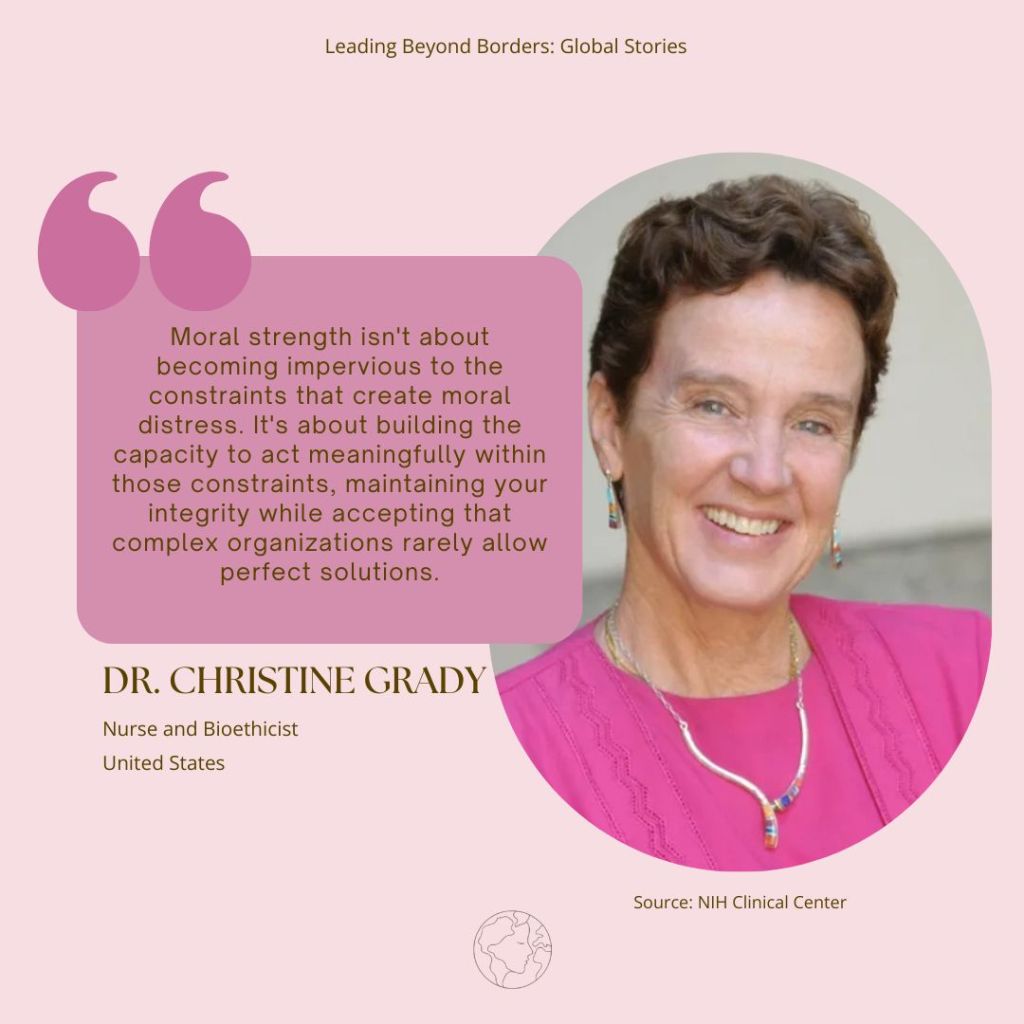
Moral strength isn’t about becoming impervious to the constraints that create moral distress. It’s about building the capacity to act meaningfully within those constraints, maintaining your integrity while accepting that complex organizations rarely allow perfect solutions.
Building Careers Across Borders and the Trust Challenge
Grady’s career took her far beyond the walls of American hospitals. She worked as a nurse in northeast Brazil at a large federal hospital that drew patients from across one of the country’s poorest states. Later, she contributed to HIV vaccine trials in Uganda and led research ethics workshops throughout Africa and Southeast Asia. These weren’t brief consulting trips. They were immersive experiences that fundamentally changed how she understood healthcare, ethics, and the context that shapes both.
The biggest lesson? Culture and context determine everything. How people understand health, what they value, how they make decisions about their care – none of this exists in a vacuum. Working in resource-constrained settings showed Grady that healthcare providers everywhere face similar ethical tensions, but the constraints differ dramatically. A question about resource allocation looks entirely different when you’re deciding who gets priority treatment in a hospital serving an entire impoverished state versus a well-funded research facility in Washington.
What struck her most was people’s strength and resilience even with minimal resources. “I learned so much about people’s strength and resilience and ability to face difficult issues even when they have minimal resources,” she reflects. That exposure to different healthcare systems opened her eyes to multiple ways of addressing the same problems. Understanding global context made her a better ethical thinker – not because international experience is somehow morally superior, but because it prevents you from assuming your way is the only way.
This cross-border perspective directly connects to one of the most pressing challenges in healthcare today: the collapse of trust in science and medical institutions. Grady identifies person-to-person contact as the most effective trust-builder. When people actually talk to each other, relate to one another, work together, and witness honesty and authenticity firsthand, trust develops naturally. You can’t manufacture it through marketing campaigns or public relations strategies.
That’s why she’s worried about the current drift toward isolationism. “I’m quite worried about right now the tendency towards isolationism. And I think that’s bad for trust, it’s bad for security, it’s bad for good relations, it’s bad for health reasons.” When countries and communities retreat into themselves, they lose those person-to-person connections that build trust across borders.
The threat gets worse when you layer in deliberate disinformation. Unlike simple misinformation (getting things wrong accidentally), disinformation involves deliberately misleading people. This destroys trust because people stop knowing what or who to trust. Everything becomes suspect. Trustworthiness requires honesty and evidence-based communication, but disinformation poisons the well entirely.
For professionals building careers across borders, Grady’s experience translates into practical guidance. Invest in building genuine relationships rather than treating international work as box-checking. Be transparent about what you know and what you don’t know – pretending to have all the answers erodes trust quickly. Understand local context before trying to impose solutions that worked elsewhere. Most importantly, create opportunities for real collaboration rather than one-way knowledge transfer where you’re the expert dispensing wisdom to grateful recipients.
The world needs more global citizens who understand that healthcare ethics can’t be developed in isolation. Different countries and cultures have legitimate insights to contribute, and the ethical frameworks that emerge from genuine cross-border collaboration will be stronger than anything developed within a single context.
Emerging Ethics Challenges in AI and Neurotechnology
The technologies reshaping healthcare are moving faster than our ability to think through their implications. Grady acknowledges something crucial here: she doesn’t fully understand all of AI’s capabilities, and those capabilities are evolving as we speak. That intellectual honesty isn’t a weakness. It’s the starting point for ethical thinking.
AI Ethics Concerns
We’re already seeing AI make decisions in clinical settings without adequate human oversight or accountability. That’s the misuse risk everyone talks about. But Grady identifies something more insidious: cognitive atrophy. When we outsource analysis and critical reasoning to AI, we stop engaging those muscles ourselves.
There’s also what gets lost in efficiency. A chatbot can cover basic patient needs – answer questions, schedule appointments, provide information. But it misses the human connection that’s valuable precisely because it’s messy and difficult. Healthcare isn’t just information transfer. The relational aspects matter, even when they’re inefficient.
The bias problem compounds everything else. AI trained on biased data doesn’t just perpetuate existing inequalities in healthcare and research – it amplifies them at scale. And we’re racing ahead anyway.
Privacy erosion is happening right now in ways most patients don’t realize. Ambient AI in clinic rooms records entire patient-provider conversations. The technology promises better documentation and fewer administrative burdens for clinicians. The privacy protections? Those are still being figured out.
Neurotechnology Ethics Concerns
Brain-computer interfaces represent both tremendous promise and profound ethical complexity. We’ve seen patients with ALS use BCIs to think their thoughts and have a computer speak them in their own voice. For people with speech disorders and neurological conditions, this technology is life-changing.
But here’s the tension: if computers can read the thoughts you want to express, how do we distinguish those from the private thoughts you don’t want shared? Our brains are central to who we are. The boundary between inner life and outer expression matters in ways we’re only beginning to understand.
There’s also a scaling problem nobody wants to talk about. Current neurotechnology successes involve handfuls of people with intensive training and resources. When we talk about making these technologies widely available, we’re raising massive access and equity questions. Who gets this technology? Who gets left behind? What happens to the gap between those with augmented cognitive capabilities and those without?
What This Means for Professionals
We need ethical frameworks before these technologies fully mature, not ethics retrofitted after problems emerge. That means bringing diverse perspectives to the table now: technologists, ethicists, clinicians, patients, and policymakers all have necessary viewpoints.
For professionals working in or adjacent to these fields, the mandate is critical engagement. Ask questions about who benefits from a technology and who might be harmed. Examine what assumptions are baked into the design. Challenge the idea that innovation is always progress.
Grady’s intellectual honesty about not fully understanding AI should be the norm, not the exception. We can’t think clearly about ethics when we’re pretending to understand capabilities we don’t. The willingness to say “I don’t know” and “we need to think about this more carefully” is exactly the moral strength these fields need right now.
Crisis Response, Resilience, and What Gives Grady Hope
Grady has worked through some of the most brutal health crises in modern history. She started her bioethics career during the early HIV epidemic at NIH, as a nurse caring for young men – people who could have been her brother or best friend – dying from an unknown illness while facing massive social stigma. Later came Ebola in West Africa, with its thorny ethical questions about outbreak response. Then five years of COVID-19, grappling with vaccine ethics, resource allocation, and eroding public trust.
You might expect someone who’s witnessed that much suffering to be cynical. She’s not.
What sustained her through decades of crisis work was witnessing something remarkable: the strength people show when circumstances are awful. HIV patients remained hopeful and strong even close to death. Healthcare workers during COVID returned for endless shifts, caring for patients through lonely, hard deaths, exhausted and overwhelmed. They kept showing up because somebody had to care for patients, and they refused to abandon that responsibility.
This pattern repeated across every crisis she’s studied. Both patients and providers demonstrated resilience that defied their circumstances. That human capacity for strength in the face of adversity is what gives Grady hope, even when everything else feels bleak.
And she’s clear-eyed about how bleak things are. “The world is a mess,” she says directly. We’re not just dealing with health crises anymore. Isolationism and disinformation threaten the progress we’ve made in global health and bioethics. The challenges are multiplying.
But here’s what keeps her grounded: good people exist. Strong, resilient people who care about doing things well exist everywhere. Young people especially give her energy – they see a better world and have good ideas about how to get there. They haven’t given up.
That belief matters even more now that Grady’s been pushed out of her NIH role after nearly 30 years. The transition forced her to ask a fundamental question: what’s my purpose without this job title?
Her answer reveals something crucial for anyone building a purpose-driven career. With or without institutional affiliation, she can still study hard issues, analyze problems, talk to people, and present knowledge and wisdom. Those capabilities don’t disappear when a job ends. The purpose persists across contexts.
This is the lesson for women navigating career transitions or questioning whether their work matters beyond their current role: purpose is not the same as a job. Your skills and expertise remain valuable regardless of where you apply them. Community and relationships matter more than titles ever will.
Grady’s finding ways to contribute through teaching, writing, speaking, and mentoring. The venue changes. The purpose doesn’t.
Mentorship Wisdom for Women Building Careers in Ethics and Healthcare
After nearly 30 years mentoring postdoctoral and post-baccalaureate fellows at NIH, Grady distills her guidance into three pieces of advice that apply whether you’re starting out or mid-career: find something you care about, be willing to pivot when opportunities arise, and keep people around you who can support you.
That first one matters more than you might think. Passion sustains you through doubt and difficulty. Grady admits she experiences imposter syndrome regularly. She’s not always the smartest person in the room or the one who knows the most. What counters that self-doubt? Caring deeply about the work. When you care, you bring what you know to the table, admit what you don’t know, and work with others to figure it out. That’s not weakness. That’s how good work actually gets done.
The pivot advice comes from lived experience. Grady’s career path went from nursing to Brazil to HIV work to philosophy to bioethics leadership. Each opportunity built on the previous one, even though she couldn’t have planned the trajectory. Very few careers are linear, especially in ethics and healthcare where the field itself keeps evolving.
Her mentorship philosophy centers on a simple premise: the goal is their success, not your credit. She helps fellows develop their career identity, find opportunities they genuinely care about, and build skills for the long term. Critically, she cares about them as people, not just professionals. Nobody is just their job. Mental health and happiness directly affect professional success.
Women face specific challenges here. Grady has observed that women are often less willing to ask for what they need than men. Good mentors don’t wait for women to request support – they actively elicit those needs. Life events like having children should be celebrated, not treated as career distractions or gaps to apologize for.
Here’s what you can do right now: Identify women in your field doing work you admire and reach out to them. Seek mentors who ask about your needs, not just your accomplishments. Build networks of peers alongside vertical mentorship relationships. Define your success by impact and growth, not titles and promotions.
Grady stays in contact with most of her fellows long after they leave NIH. Some are now field leaders themselves. That continued connection matters – for purpose, for resilience, and for lasting impact. Community isn’t just nice to have. It’s essential.
What This Means For You
Dr. Grady’s journey offers a blueprint for navigating uncertainty in healthcare careers: follow the ethical tensions that won’t let you go, build frameworks to address them, and trust that expertise at intersections creates value even in fields that don’t yet exist. Her forced departure from NIH after 40 years proves that institutional titles are temporary, but the work of thinking clearly about hard problems transcends any single role.
The bioethics frameworks she’s spent decades developing aren’t just for philosophers or policy makers. They’re practical tools for the nurse questioning resource allocation decisions, the researcher designing trials, the administrator navigating AI implementation, or any healthcare professional drowning in moral distress. You’re already doing bioethics work – you just need the language and structures to do it more effectively.
The stakes are rising. Healthcare systems are more complex, technology is advancing faster than policy can follow, and professionals face impossible choices with diminishing support. Building moral courage and ethical fluency isn’t optional anymore.
Subscribe to the Women Beyond Borders podcast to hear the full conversation with Dr. Grady and access more interviews with women creating impact across borders.
FAQ
What is bioethics and how is it different from medical ethics?
Bioethics is moral philosophy applied to healthcare, research, public health, and policy. It addresses systemic questions about how we ought to act when science, medicine, and human values collide. Medical ethics focuses on bedside clinical decisions and the patient-clinician relationship. Bioethics zooms out to examine bigger questions: resource allocation across populations, clinical trial design, institutional policies, and frameworks that shape entire healthcare systems. When you’re wrestling with whether a desperate patient truly understands research risks, or how to fairly distribute limited treatments, you’re navigating bioethical terrain even if you don’t call it that.
What does moral distress mean and how can I tell if I am experiencing it?
Moral distress happens when you know the right thing to do but can’t do it because of constraints beyond your control. You might feel powerless against institutional barriers, frustrated by policies that conflict with your values, or trapped when colleagues or hierarchies prevent ethical action. Common signs include persistent frustration about being unable to provide the care you believe patients deserve, feeling complicit in decisions you consider wrong, or emotional exhaustion from repeated value conflicts. While prevalent in healthcare, moral distress occurs across any profession where external constraints prevent you from acting according to your ethical judgment.
How do you build moral courage when speaking up feels risky?
Start by identifying allies who share your concerns. Frame issues in terms of shared goals and patient welfare rather than personal preference. Document your concerns systematically. Seek ethics consultation or institutional support channels when available. Refuse to do things you believe are wrong – that has to be acceptable even in hierarchical systems. Building moral courage isn’t about grand gestures; it’s about consistently naming ethical tensions, asking clarifying questions about decisions that trouble you, and creating space for others to voice concerns. You’re often not alone in seeing the problem; you’re just the first to name it.
What educational background do you need to work in bioethics?
Pathways vary considerably. Dr. Grady combined nursing experience with a philosophy PhD. Many bioethicists have clinical backgrounds in nursing, medicine, or public health plus graduate training in ethics, philosophy, or bioethics. Others come from philosophy, law, theology, or social sciences. The field strengthens when people bring diverse backgrounds and perspectives. If you’re working in healthcare or research and drawn to ethical questions, you’re already equipped to start. Formal bioethics training provides frameworks and methodology, but the field values real-world experience navigating ethical dilemmas as much as academic credentials.
How can I apply ethical thinking in my current healthcare or research role even if I am not a bioethicist?
Name ethical tensions when they arise rather than staying silent. Learn basic frameworks around informed consent, autonomy, beneficence, justice, and non-maleficence. Seek ethics consultation when facing difficult decisions – that’s what these services exist for. Read accessible bioethics resources to develop your ethical vocabulary. Recognize that ethical thinking isn’t the exclusive domain of bioethicists. You make ethical decisions daily whether you call them that or not. Bioethics knowledge simply gives you language and systematic tools to navigate dilemmas more intentionally rather than relying solely on gut instinct or institutional inertia.
 WBB: Women Beyond Borders
Leave a comment